When a Sudoku stops giving you cells, the answer is almost never to guess. It is to switch techniques. Each method below finds something the one before it cannot, and they are in the order you should try them, from the fastest scan to the one you save for hard puzzles. For each there is a way to spot the pattern, the rule that makes it work, and a small example you can check by hand. The post ends with how Sudoku Throne, the Sudoku app by IEUMAPPS, teaches the same techniques inside the game.
A note on names: the techniques have standard names that Sudoku books share, and the app uses plainer labels. Both are given, so you can match them.
Before you start: scan, then write candidates
Two habits make every technique below easier.
- Scan by digit. Pick a digit, say 7, and look at where it already sits. Every row, column and 3x3 box that has a 7 cannot take another. Run through 1 to 9 this way before anything else.
- Write candidates. When the scan runs dry, note the digits that could still go in each empty cell. Techniques 3 to 5 are impossible to see without candidates; with them, the patterns are visible on the board.
If you are new to Sudoku, this is also the whole method for easy puzzles. The techniques start where the scan stops.
1. Naked single (app: Only option)
What it is. A cell where only one digit is still possible.
How to spot it. Look at an empty cell and list the digits already in its row, its column and its box. If eight of the nine are taken, the ninth goes in.
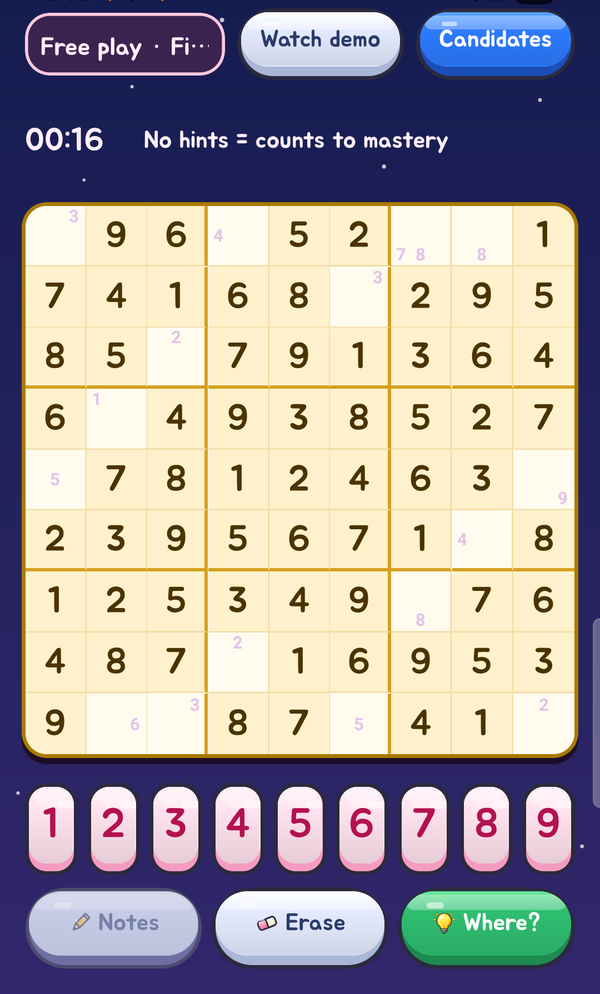
Example. The centre cell of the board. Its row already holds 1, 2, 3 and 4 somewhere outside the centre box. Its column holds 5 and 6 outside the box. The centre box itself holds 7 and 8. Eight digits are ruled out, so the cell is 9. Check: 1-4 by row, 5-6 by column, 7-8 by box, and nothing else is possible.
The simplest case is a row, column or box with one empty cell left; the missing digit goes there. Sudoku Throne calls that one Last cell and treats it as the first skill.
2. Hidden single (app: Box single, Line single)
What it is. A digit that can go in only one cell of a box, row or column, even though that cell could still take other digits.
How to spot it. Take a box that is missing a digit. For each empty cell in the box, ask whether that digit is already in the cell's row or column. Cross those cells off. If one cell is left, the digit goes there.
Example. The top-left box looks like this, with dots for empty cells:
5 . .
. 8 .
. . 2
The box has no 4. Suppose there is a 4 somewhere in row 1 to the right of the box, a 4 in row 2 to the right of the box, and a 4 in column 1 below the box. Then the two empty cells of row 1 cannot take the 4, the two empty cells of row 2 cannot, and the empty cell in column 1 (bottom-left) cannot. The only cell left is the bottom-middle one, so it is 4. The cell might have had other candidates; that does not matter, because the 4 has nowhere else to go in this box.
The same idea works along a row or a column instead of a box, which is why the app has two cards for it.
3. Pointing pair (app: Pointing)
What it is. A digit whose only possible cells inside a box all lie on one row (or one column). The box forces that digit onto that line, so the digit is removed from the rest of the line outside the box.
How to spot it. With candidates written, pick a box and a digit it is missing. If the candidates for that digit sit in two or three cells that share a row, you have it.
Example. In the top-left box, the digit 7 can go only in the first two cells of row 1. Wherever the 7 ends up in that box, it will be in row 1. So no other cell in row 1, columns 4 to 9, can be a 7, and you erase 7 from their candidates. This technique places nothing by itself. It removes candidates, and the next naked or hidden single usually appears from what is left.
4. Naked pair (app: Pairs)
What it is. Two cells in the same row, column or box that have exactly the same two candidates and nothing else. Those two digits must occupy those two cells, so they are removed from every other cell in that unit.
How to spot it. Scan your candidate notes for cells with exactly two digits. When two such cells in one unit show the same two digits, that is the pair.
Example. In row 4, the second and sixth cells both have candidates 3 and 8 and nothing more. One of them is the 3 and the other is the 8, in some order you do not yet know. Either way, no other cell in row 4 can be a 3 or an 8, so remove both from the other seven cells' candidates. If one of those cells drops to a single candidate, you have a naked single.
The same logic extends to three cells sharing three digits, which the app calls Triples.
5. X-Wing
What it is. A digit that, in two different rows, can only go in the same two columns. That makes a rectangle of four cells. The digit must occupy two opposite corners of the rectangle, so it is removed from the rest of those two columns.
How to spot it. Pick a digit. Look for a row where it has exactly two candidate cells. Then look for a second row where it also has exactly two, in the same two columns.
Example. The digit 5 in row 2 can only go in column 3 or column 7. In row 8, it can also only go in column 3 or column 7. Row 2 needs a 5 and row 8 needs a 5. If row 2 takes column 3, row 8 must take column 7; if row 2 takes column 7, row 8 must take column 3. Either way, column 3 gets its 5 from row 2 or row 8, and so does column 7. So any 5 candidate elsewhere in columns 3 and 7, in rows 1, 3 to 7 and 9, can be erased.
          c3        c7
row 2      5?        5?
row 8      5?        5?
Swap rows and columns and it works the other way: two columns, same two rows, eliminate along the rows. X-Wing is the first technique here that needs the whole board in view, which is why it belongs at the end of the list and not the start.
The order matters
Run the list top to bottom every time you stall: singles first, because they are fast and place digits; then pointing pairs and naked pairs, which thin the candidates; then X-Wing when the easier patterns are gone. After any technique places a digit or removes a candidate, go back to the top, because new singles usually appear. Most puzzles labelled medium never need step 5. Most puzzles labelled hard need it a few times, and then collapse into singles again.
How Sudoku Throne teaches these
Sudoku Throne (by IEUMAPPS) is a Sudoku game for Android and iPhone with an Adventure of 9 lands, ghost and friend battles, and a Training area built around the techniques in this post.
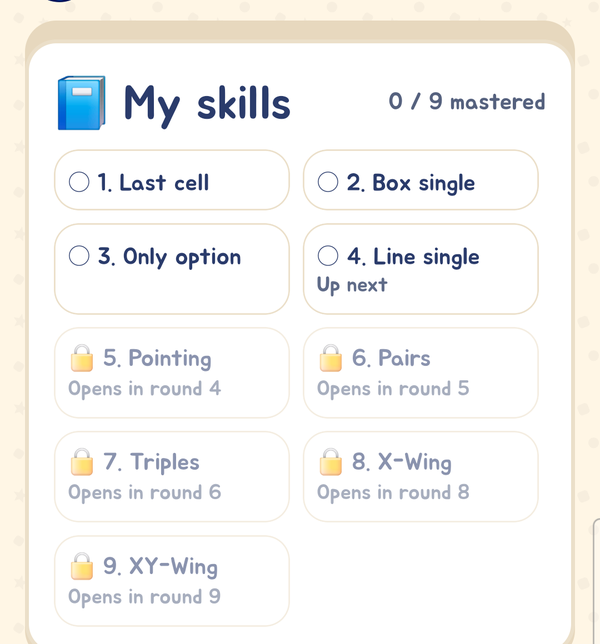
- Skill cards. The My skills list in Training has nine cards in difficulty order: Last cell, Box single, Only option, Line single, Pointing, Pairs, Triples, X-Wing and XY-Wing. Cards open as your Adventure round goes up. A card you have not reached yet shows a lock and "Opens in round N" (on a fresh install: Pointing in round 4, Pairs in round 5, Triples in round 6), and the one you may practise ahead of time is marked "Up next". The last two cards read "Opens in round 8" and "Opens in round 9", but the X-Wing and XY-Wing drills are not included in the current version, so for now the practice puzzles stop at Triples.
- A coach in three steps. In a training puzzle the coach first shows where to look, then explains why, then lets you make the move yourself. A puzzle solved without hints counts toward mastering that skill.
- Candidates on tap. Training puzzles have a Candidates switch that fills in the notes for you, which is the quickest way to see a pointing pair or a naked pair for the first time.
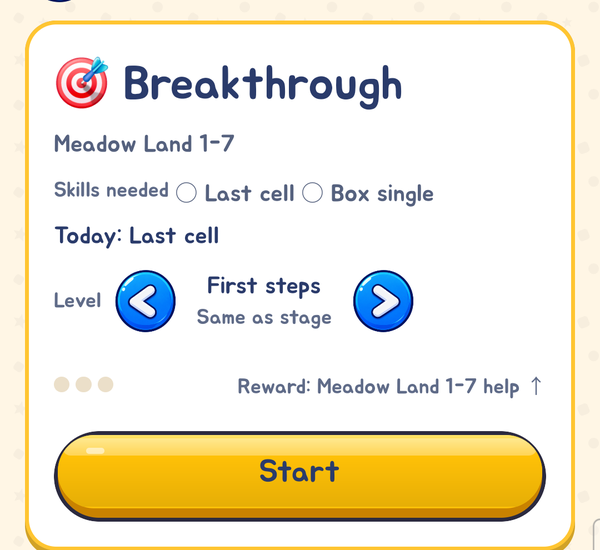
- Breakthrough training. If an Adventure stage keeps beating you, Training builds three puzzles that use the same techniques as that stage, so you practise exactly the pattern that is blocking you.
- Hints that say why. In Adventure, a hint reveals one cell and tells you the reason, for example "Only one digit fits" or "Only spot in this box". Hints are bought with coins you earn by playing; they are not sold for money.
The game is free, with full-screen ads between puzzles and none during play; a one-time Lifetime Premium purchase removes them. There is no sign-up. English, Korean and Japanese are supported, and it is on Google Play and the App Store.
FAQ
What is the difference between a naked single and a hidden single? A naked single is a cell with only one possible digit. A hidden single is a digit with only one possible cell in a row, column or box, even if that cell still shows other candidates. The first is found by looking at a cell; the second by looking for a digit.
When should I use X-Wing in Sudoku? Only after singles, pointing pairs and naked pairs have stopped producing moves. Pick one digit, find a row where it has exactly two candidate cells, then look for a second row with the same two columns. It never places a digit directly; it removes candidates from the two columns so that singles reappear.
Does Sudoku Throne teach X-Wing? The X-Wing and XY-Wing cards are in the My skills list, shown locked with "Opens in round 8" and "Opens in round 9", but their practice drills are not included in the current version. The drills you can play cover Last cell, Box single, Only option, Line single, Pointing, Pairs and Triples, each opening at its Adventure round, with a coach that shows where to look and why.
If you would like the techniques above as drills with a coach beside the board, Sudoku Throne is on Google Play and the App Store.